
Vitalia · Guides
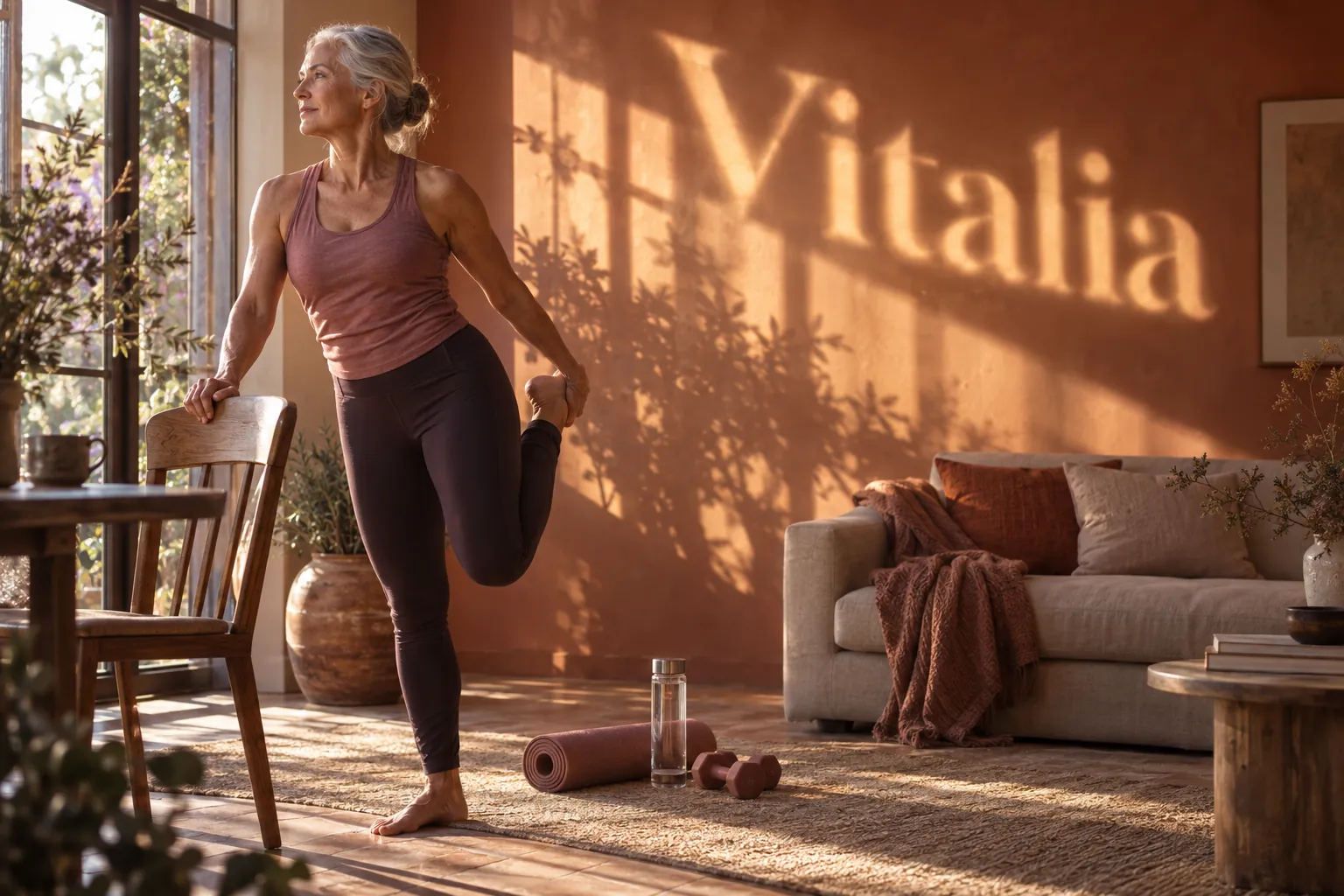
Chair exercises for women over 50
A complete standing and seated workout built around a sturdy chair, for stiff mornings, small flats and days when the floor is not an option.
In this guide6
Why a chair is a serious piece of equipment
A chair does three jobs a gym machine does: it gives you a fixed height to squat to, a stable handhold for balance work, and a raised surface that makes pushing exercises the right difficulty for arms that are not strong yet. It also removes the two reasons women most often stop training at home, getting down to the floor and getting back up. Everything below can be done in a metre of space beside a dining chair, in ordinary clothes.
Warm up while you are still holding the chair
Thirty seconds each: march on the spot with a hand on the back rest, roll the shoulders backwards, rise onto your toes and lower slowly, and swing one leg gently forwards and back, then the other. Two minutes total. The point is not to burn energy but to let joints move through their range before you load them, which makes the first working set feel like the third.
The seated block
Sit tall, feet flat. Seated marches, lifting each knee in turn, twenty in total. Seated leg extensions, straightening one knee and lowering slowly, ten each side. Seated rows with a band around your feet or two shopping bags, twelve. Seated overhead presses with tins or light weights, ten. Each set should end feeling difficult, not pleasant. Rest a minute between sets, longer if you need it.
The standing block
Sit-to-stands, from the chair without using your hands if you can, eight to twelve. Incline push-ups with hands on the chair seat or a worktop, eight. Hip hinges, reaching your hands towards the back rest and standing tall again, ten. Split squats with one hand resting on the chair, six each leg. Calf raises, holding the chair, fifteen. This block is where the strength change comes from, so make it hard enough that the last repetitions are slow.
| Exercise | Reps | Making it harder |
|---|---|---|
| Sit-to-stand | 8-12 | No hands, then hold a weight |
| Incline push-up | 8 | Lower surface |
| Hip hinge | 10 | Hold a bag in both hands |
| Split squat | 6 each leg | Less hand support |
| Calf raise | 15 | One leg at a time |
Balance, every session
Stand behind the chair, hands hovering just above it. Feet together, thirty seconds. One foot in front of the other, thirty seconds each way. Then, if it is safe, a single-leg stand for as long as you can hold it, up to thirty seconds a side. Fall prevention is one of the best evidenced benefits of exercise in older adults, and balance work is the ingredient that reviews keep identifying as necessary.
How to make it harder over the weeks
Slow the lowering phase to three seconds before adding weight, then add a book or bottle in a bag, then reduce the chair height by sitting on a cushion instead. Progress one thing at a time. A session that felt hard in week one and identical in week eight is no longer training, it is maintenance, and while maintenance has value it will not keep changing your strength.
Questions
Are chair exercises enough to get stronger after 50?
Yes, at the start. Sit-to-stands, incline push-ups and split squats with a chair load the same patterns a gym would. Once they feel easy, add weight or reduce support rather than adding repetitions forever.
I cannot get down on the floor. Can I still train?
Everything in this session is done seated or standing beside a chair, so the floor is never needed.
How often should I do a chair session?
Two to three times a week, with a day between sessions, is enough to build strength while leaving time to recover.
Further reading
- Sherrington et al. (2019), Exercise for preventing falls in older people living in the community, Cochrane Database of Systematic Reviews
- World Health Organization 2020 guidelines on physical activity and sedentary behaviour, British Journal of Sports Medicine
- Garber et al. (2011), Quantity and quality of exercise for developing and maintaining fitness in apparently healthy adults, Medicine & Science in Sports & Exercise
Guides
Menopause workout plan for women over 50
What a sensible training week looks like during perimenopause, menopause and after: how many sessions, how hard, and what to do on the days you feel flat.
Strength training for women over 50: the first four weeks
A beginner’s path into strength training after 50, with the five movements that matter, how many sets, and how to know you are working hard enough.
Menopause belly fat: what exercise really changes
Why fat moves to the middle during menopause, what training actually does about it, and which promises to ignore.
Bone-strengthening exercise after menopause
Which exercise protects bone after menopause, what the LIFTMOR trial found, and how to train safely if you have been told your bone density is low.
Pelvic floor exercises during menopause
Leaks when you cough, laugh or lift are common after menopause and often improve with training. Here is what the evidence supports and how to practise correctly.
Balance exercises after 50 to prevent falls
Falls are the outcome exercise prevents best. What the Cochrane review found, and a five-minute daily balance routine you can do in a kitchen.
How much protein for a woman over 50
Protein targets for women over 50 from the PROT-AGE recommendations, why spreading it across the day matters, and what a day of ordinary food looks like.
Menopause, sleep and energy: what exercise changes
An honest look at exercise, hot flushes, broken sleep and low energy during menopause, including where the evidence is weak.
Firmer arms after 50: the exercises that work
Why the back of the arm softens after 50, what training changes, and a short arm session you can do beside a worktop.
Perimenopause to postmenopause: adapting your training
The three stages defined by the STRAW+10 framework, what changes physically in each, and how to adapt training rather than starting over.
Strength training after 50: a safe starting checklist
How to begin with manageable movements, recovery and clear goals without turning an exercise app into medical advice.