
Vitalia · Guides
Balance exercises after 50 to prevent falls
Falls are the outcome exercise prevents best. What the Cochrane review found, and a five-minute daily balance routine you can do in a kitchen.
In this guide6
This is where the evidence is strongest
Of everything sold to women over 50 in the name of health, exercise for fall prevention has the best evidence behind it. A Cochrane review of exercise for preventing falls in older people living in the community found that exercise programmes reduce the rate of falls, with the effect concentrated in programmes involving balance and functional training. This is not a marginal claim: it is one of the most robust findings in preventive medicine for this age group.
Balance is a skill, so it is trained like one
Balance improves when it is challenged, briefly and often, not when it is avoided. That means standing in positions that feel slightly unstable, near a support you do not use unless you need it. Five minutes a day beats thirty minutes a week, because the nervous system learns from frequency. You can build the whole routine into times you are already standing still.
The five-minute kitchen routine
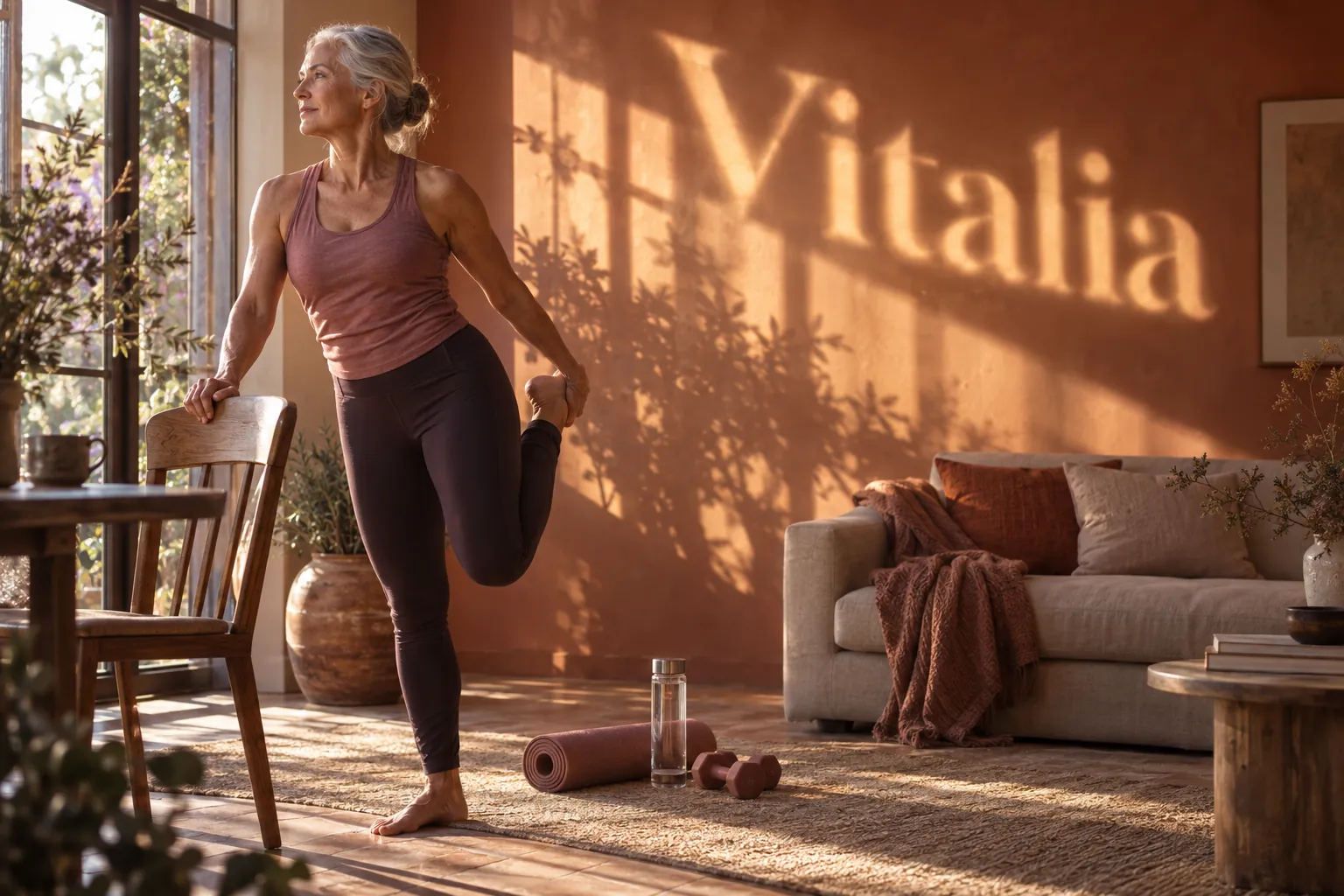
While the kettle boils: feet together, thirty seconds. Heel to toe in a line, thirty seconds each way. One-leg stand, up to thirty seconds each side. Heel raises with slow lowering, fifteen. Sideways walking along the worktop, ten steps each way. Hands hovering over the surface, not resting on it, is the difference between practising balance and practising leaning.
| Exercise | Time | Support |
|---|---|---|
| Feet together | 30 s | Hands above worktop |
| Heel to toe | 30 s each way | Hands above worktop |
| One-leg stand | Up to 30 s each | Fingertips if needed |
| Slow heel raises | 15 | Light hold |
| Sideways walking | 10 steps each way | Along a worktop |
Make it harder honestly
When a position becomes easy, progress in this order: reduce hand contact, then close your eyes for part of it, then turn your head side to side while holding, then stand on a folded towel. Never add two at once, and never practise on a soft surface next to a hard edge. Difficulty should come from the task, not from the risk of the room.
Strength is half of balance
Catching yourself requires strength that arrives quickly, especially in the hips and calves. That is why the reviews find programmes combining balance and strength work better than balance alone. Sit-to-stands, split squats and calf raises are not separate from your balance training; they are the part that lets a wobble stay a wobble.
What to fix in the room
Two thirds of the risk is the environment. Loose rugs, trailing cables, poor light on the stairs, no rail in the bathroom, reading glasses worn while walking, and slippers with no back are the usual list. Ten minutes fixing those is worth as much as a month of training, and it costs nothing.
Questions
Does exercise really prevent falls?
A Cochrane review of community-dwelling older people found exercise reduces the rate of falls, with the benefit concentrated in programmes that include balance and functional training.
How often should I practise balance?
Briefly and daily. Five minutes most days beats one long session a week, because balance is a skill that improves with frequency.
Is it safe to practise balance alone at home?
Yes, if you stand beside a stable worktop or chair with your hands hovering above it, and you never practise on a soft surface next to a hard edge.
Further reading
- Sherrington et al. (2019), Exercise for preventing falls in older people living in the community, Cochrane Database of Systematic Reviews
- World Health Organization 2020 guidelines on physical activity and sedentary behaviour, British Journal of Sports Medicine
- Garber et al. (2011), Quantity and quality of exercise for developing and maintaining fitness in apparently healthy adults, Medicine & Science in Sports & Exercise
Guides
Menopause workout plan for women over 50
What a sensible training week looks like during perimenopause, menopause and after: how many sessions, how hard, and what to do on the days you feel flat.
Strength training for women over 50: the first four weeks
A beginner’s path into strength training after 50, with the five movements that matter, how many sets, and how to know you are working hard enough.
Menopause belly fat: what exercise really changes
Why fat moves to the middle during menopause, what training actually does about it, and which promises to ignore.
Bone-strengthening exercise after menopause
Which exercise protects bone after menopause, what the LIFTMOR trial found, and how to train safely if you have been told your bone density is low.
Pelvic floor exercises during menopause
Leaks when you cough, laugh or lift are common after menopause and often improve with training. Here is what the evidence supports and how to practise correctly.
Chair exercises for women over 50
A complete standing and seated workout built around a sturdy chair, for stiff mornings, small flats and days when the floor is not an option.
How much protein for a woman over 50
Protein targets for women over 50 from the PROT-AGE recommendations, why spreading it across the day matters, and what a day of ordinary food looks like.
Menopause, sleep and energy: what exercise changes
An honest look at exercise, hot flushes, broken sleep and low energy during menopause, including where the evidence is weak.
Firmer arms after 50: the exercises that work
Why the back of the arm softens after 50, what training changes, and a short arm session you can do beside a worktop.
Perimenopause to postmenopause: adapting your training
The three stages defined by the STRAW+10 framework, what changes physically in each, and how to adapt training rather than starting over.
Strength training after 50: a safe starting checklist
How to begin with manageable movements, recovery and clear goals without turning an exercise app into medical advice.