
NailSafe · Guides
Nail progress photos: how to take pictures you can actually compare
Why photographs beat memory for a slow-changing habit, how fast nails really grow, the setup that makes two pictures comparable, and why no date should be promised.
In this guide16
Why photographs are the right feedback here
Nail biting changes appearance slowly, and slow change is exactly what people cannot judge from the inside. You see your own hands constantly, which makes any gradual improvement invisible, and you look at them most attentively on the days you are unhappy with them, which biases the impression further. A photograph taken the same way each time removes both problems, because it compares two moments rather than a moment against a feeling.
Why memory will not do this
Ask someone how their nails looked a month ago and you will get a description shaped by how they feel today. Memory for appearance is reconstructive and it smooths, and it is particularly unreliable for something you have strong feelings about. This is not a personal failing, it is how remembering works. The photograph exists because your impression of the last month is not evidence about the last month.
How fast nails actually grow
A study by Yaemsiri and colleagues published in 2010 measured nail growth in twenty-two healthy American young adults and reported an average fingernail growth rate of about 3.5 millimetres per month, faster than toenails. The sample was small and young, so treat it as an order of magnitude rather than a personal prediction. The practical consequence is unavoidable: growing out a damaged edge is a matter of months, not weeks, regardless of how well the habit is going.
What that means for your expectations
If appearance is your only measure, you will conclude nothing is working for the first several weeks even when the behaviour has already changed. That gap between behavioural progress and visible progress is where most attempts are abandoned. Photographs help precisely because they let you see a change over two months that is invisible over two days, but they cannot make the nail grow faster.
The setup that makes photos comparable
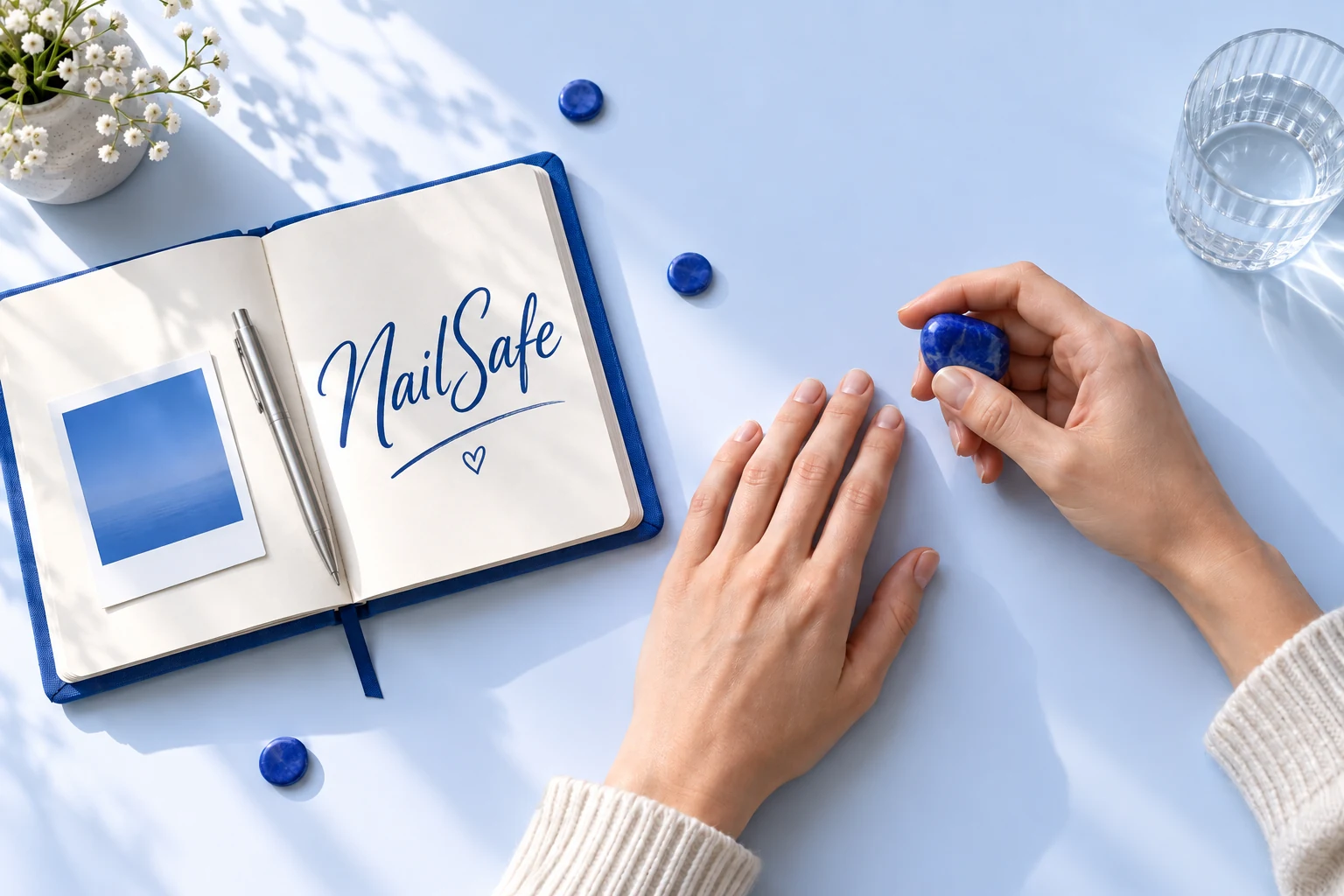
Comparability comes from repeating four things: the distance, the hand position, the light and the background. Get those consistent and two pictures a month apart become genuinely informative. Vary them and you will produce a series in which the differences are mostly photographic, which is worse than no series at all because it invites false conclusions in both directions.
Distance and framing
Fill the frame with the hand the same way each time. The simplest reliable method is to rest your hand flat on a surface and hold the phone directly above it at roughly the same height, using an edge of the surface as a guide for where the hand goes. If your first photo puts the wrist at the bottom edge, keep doing that. Consistency matters more than the framing being ideal.
Light
Use the same light source at the same time of day if you can, and avoid direct flash, which flattens texture and exaggerates redness. Daylight from a window is easier to reproduce than a ceiling light because it does not change colour when a bulb is replaced. Shadows are the main thing that makes two otherwise identical photographs look different.
Background
A plain, mid-toned surface works best. A busy or very dark background changes how the camera exposes the image, which changes the apparent colour of skin and nail. Using the same table each time removes a variable at no cost.
Hand position
Fingers relaxed and slightly spread, palm down, the same hand each time. Do not straighten or arrange the fingers into a flattering pose, because you will not reproduce it, and a pose that changes between sessions is indistinguishable from a change in the nails. If you photograph both hands, photograph both every time.
How often to take them
Every one or two weeks is enough, and weekly is the practical maximum given the growth rate above. Daily photographs produce a series in which nothing changes between adjacent frames, which is discouraging rather than informative. Attach the photograph to something that already happens weekly so it does not depend on remembering.
Keep the originals
Never crop, filter, retouch or adjust the brightness of a progress photograph, and keep the original file. An edited photo cannot be compared with an unedited one, and the temptation to improve a picture is strongest on the days when the honest record matters most. The value of the series is that it is unflattering when it should be.
Compare yourself with yourself only
There is no reference set of correct nails, and comparing your hands with pictures found online tells you nothing except how you feel afterwards. The only comparison that carries information is between two of your own photographs taken the same way. That is also the only comparison that can show progress rather than a gap.
Do not set a date
Deciding that your nails should look a certain way by a certain date converts a slow biological process into a deadline you cannot control, and missing it feels like failure even when the behaviour has genuinely improved. Photographs are there to show what happened, not to hold you to a schedule. NailSafe deliberately sets no recovery deadline for this reason.
What photographs will not show
They will not show whether the habit is improving, only what the nails look like. Behaviour and appearance move on different timescales, so keep the record of episodes alongside the photographs rather than instead of them. A month where you noticed and interrupted many episodes is progress even if the pictures look identical.
When to bring them to a professional
A photographic series is genuinely useful in a consultation, because it shows a clinician a change over time that a single examination cannot. Bring it if there is bleeding, infection, persistent pain, or damage to the nail fold and surrounding skin. Onychophagia and its consequences are described in the dermatological literature, and a doctor or dermatologist can treat the physical damage that a habit-support tool cannot.
Where NailSafe fits
NailSafe keeps a photo journal with consistent framing so that the four variables above stay fixed without you having to think about them, and stores the pictures alongside the record of situations that trigger the gesture. It promises no recovery deadline and no result. It is a habit-support tool, not a diagnosis or a treatment, and injury, infection or significant distress are reasons to see a professional.
Questions
How fast do fingernails grow back?
A 2010 study by Yaemsiri and colleagues measured nail growth in twenty-two healthy young adults and reported an average fingernail rate of about 3.5 millimetres per month. The sample was small, so treat it as an order of magnitude. Either way, growing out a damaged edge takes months rather than weeks.
How often should I take nail progress photos?
Every one or two weeks. Daily photographs show no change between adjacent frames, which discourages rather than informs, and weekly is already close to the maximum useful frequency given how slowly nails grow.
How do I make two nail photos comparable?
Repeat four things every time: the distance, the hand position, the light and the background. Rest your hand flat on the same surface, shoot from directly above at the same height, use daylight rather than flash, and keep fingers relaxed rather than posed.
Should I edit or crop progress photos?
No. Keep the original file and never crop, filter or adjust brightness, because an edited photo cannot be compared with an unedited one. The temptation to improve a picture is strongest on the days when an honest record matters most.
Why should I not set a target date for my nails?
Because it converts a slow biological process into a deadline you cannot control, and missing it feels like failure even when the behaviour has genuinely improved. Photographs are there to show what happened, not to enforce a schedule.
Further reading
- Yaemsiri, Hou, Slining & He (2010), Growth rate of human fingernails and toenails in healthy American young adults, Journal of the European Academy of Dermatology and Venereology
- Halteh, Scher & Lipner (2017), Onychophagia: a nail-biting conundrum for physicians, Journal of Dermatological Treatment
- American Academy of Dermatology: How to stop biting your nails
Guides
How to track nail biting without chasing a streak
What to record and why, how a streak counter can work against you, using desk reminders deliberately, and how to read a week of entries into a plan.
How to stop biting your nails: the methods with evidence behind them
A step-by-step account of habit reversal training for nail biting, what a competing response is, what to change in your environment, and what to do after a slip.
Apps to stop biting your nails, compared
Habit trackers, awareness tools, bitter coatings and clinical programmes: what each approach actually does, what it cannot do, and how to check any of them before you install.