
Dual N-Back · Guides
How to play dual n-back: a clear first session
Understand position matches, sound matches and the meaning of N before your first dual n-back session.

In this guide16
What you are about to do
A dual n-back session shows you two things at once, over and over: a square lights up somewhere on a three-by-three grid, and a letter is spoken. A new pair arrives every couple of seconds, and your job on each pair is to answer two separate questions. Is this position the same as the one N turns ago? Is this sound the same as the one N turns ago? That is the whole task. Everything that makes it difficult comes from the fact that nothing is written down and the window you are comparing against keeps moving.
What N means
N is a distance measured in turns, not in seconds. At N=2, you compare what you are seeing now with what appeared two turns ago, not with the previous item and not with something two seconds old. This distinction is the single most common source of confusion in a first session. If the third square lights in the same place as the first square did, that is a position match at N=2. If the third letter is the same as the first letter, that is a sound match. The two are judged independently.
Two turns earlier: compare each stream separately
Two answers, and one of them is silence
In dual n-back, apply that same distance independently to the position and the sound. A position match does not imply a sound match, and you may need to answer either channel, both, or neither.
Your first two minutes
At N=1, a sound or position is a match when it repeats the immediately previous sound or position. This can be a useful place to learn the controls, distinguish the two response channels and understand when not to press. It can also be challenging depending on the pace, the person and the settings. There is no universal number of introductory sessions, and staying at N=1 is not inherently useless. Move on when you understand the rules and want to try a longer comparison interval.
Dual N-Back settings on iPhone: audio, feedback and levelsMoving to N=2
Consider the spoken sequence A, B, A. At the third trial, the current A matches the A from two trials earlier, so the sound response is appropriate at N=2. The middle B is not the comparison item. For position, compare the third position with the first position independently. In the sequence A, A, B, the second A repeats a recent item, but that immediate repetition is not an N=2 sound match. Familiarity is not enough: the distance must also be right.
Keep the comparison rule explicit
You may try repeating letters or grouping signals, but no single strategy is established here as best for everyone. Check whether it helps you compare with exactly N turns earlier without losing the other stream. A familiar signal is not necessarily a match. If you lose track, work through a short written example before restarting.
Keep the two streams apart
Compare the position and sound independently with the items from exactly N turns earlier. A position match does not imply a sound match. Check which channel matches before choosing its response button; both channels or neither may match. If you confuse the buttons or lose track, pause and work through a short written example before starting a new attempt.
No sound in dual n-back on iPhone? Checks to tryPress when you identify a match
Decide separately whether the position and sound match the items from exactly N turns earlier. Press the relevant response button when you identify a match. When there is no match in a channel, not pressing that channel’s button is the correct response. Guessing can produce both hits and false alarms; it does not automatically raise the score. Inspect these outcomes rather than treating frequent presses as evidence of improvement.
Read the settings before comparing scores
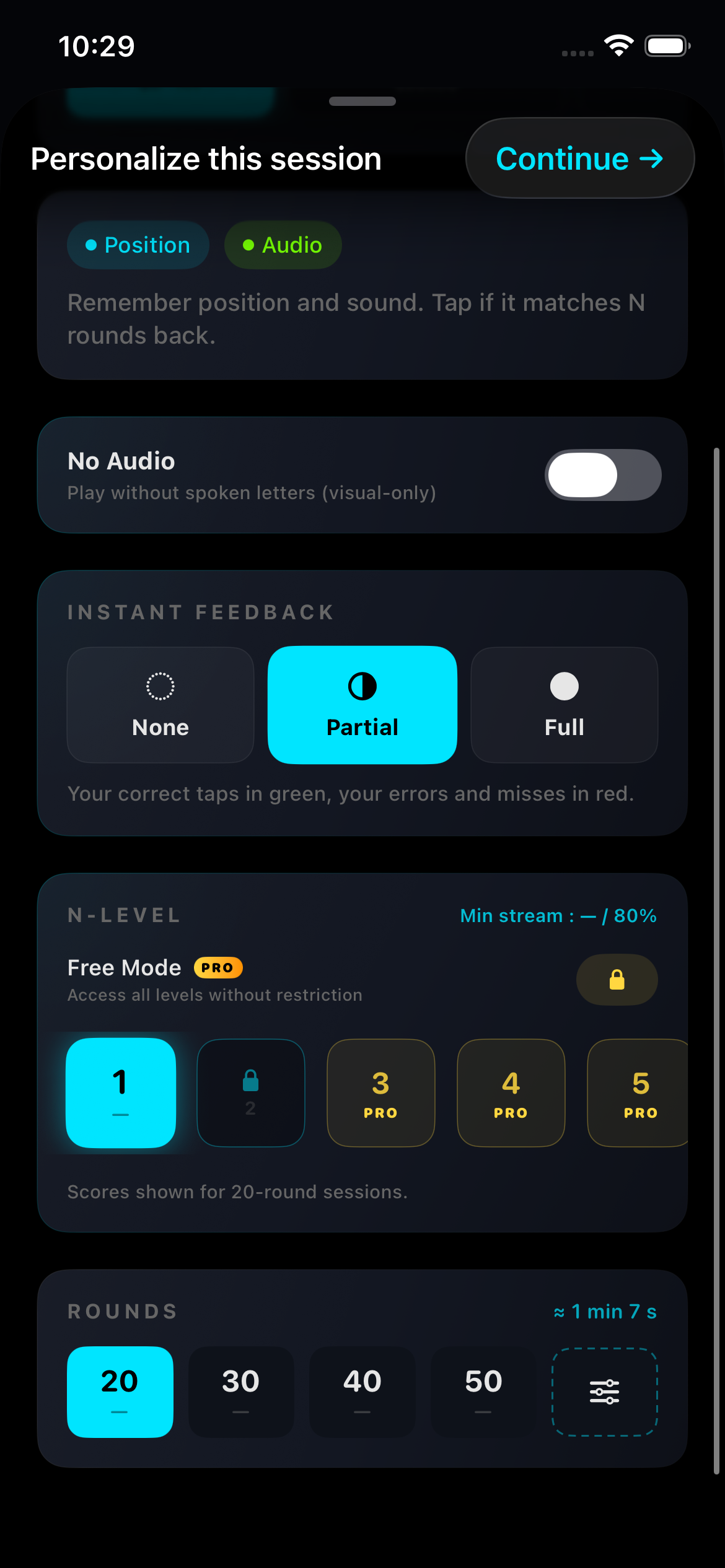
Actual app capture · September 2026 · interface language may differ · EN · 2026-09-06
How long a first session should be
Keep the first attempt short enough to follow the comparison rule, and stop if you feel tired or lose track. No universal practice duration is recommended here. If you want to try again, choose a suitable time and check the settings rather than extending practice to reach a fixed number of minutes.
Reading your results
Separate a hit, a missed match, a false alarm and a correct non-response. Pressing on every trial can detect many matches while producing many false alarms. Never pressing can avoid false alarms while missing every match.
Dual n-back scoring: formulas, examples and calculatorWhy the overall percentage can mislead
A total percentage is hard to interpret unless you know how it combines those outcomes. Where the app provides them, compare the two channels and their errors. If the display only provides an aggregate score, avoid inventing more detailed conclusions than it supports.
What a normal first week looks like
A flat level trend has several possible explanations: ordinary variation, changed settings, inconsistent practice conditions or a genuine plateau on the task. The graph alone cannot tell you which explanation is correct. Compare several sessions rather than just the best score; note interruptions and changes in pace or mode.
How long and how often to train dual n-back: what the studies actually didWhen to move up a level
A practical approach is to try a higher N after several sessions in which you follow the rule reliably and understand your errors. This is a way to organize practice, not a proven dosage for cognitive improvement. There is no requirement to reach a particular level by a certain date. If the app adapts automatically, check how its rule works before interpreting a level change. Prefer a deliberate experiment with comparable settings over chasing the largest number on one unusually good block.
What to expect from the exercise
Keep the conclusion specific: improved accuracy at a particular N shows improvement on that task under those conditions. It does not establish an increase in IQ, a clinical benefit or better performance at school or work. The separate evidence guide explains why improvement on the practiced task and transfer to other activities are different questions.
A checklist for your first session
Sit somewhere quiet and check the controls. N=1 can help you learn the rule; try N=2 when you understand it and want to compare items more turns apart. Press the relevant button only when you identify a match. Stop if you feel tired or lose track. Note the level, hits and false alarms. Compare several completed sessions under similar settings without imposing a universal number of minutes or sessions. Dual N-Back displays accuracy for completed sessions; these records do not establish a general cognitive benefit.
Work through one mistake before restarting
Write down a short N=2 sequence: positions A, B, A, C and sounds K, L, M, L. On turn three, only the position matches. On turn four, only the sound matches. If your answers differ, check each comparison separately instead of remembering a single position-sound pair.
Before the next session, check the selected level, the difference between the two response buttons and whether you can hear each letter. Afterwards, note the difficulty and one concrete observation. An average alone cannot explain why an error happened.
Questions
How do you play dual n-back for the first time?
At N=1, a sound or position is a match when it repeats the immediately previous sound or position. This can be a useful place to learn the controls, distinguish the two response channels and understand when not to press. It can also be challenging depending on the pace, the person and the settings. There is no universal number of introductory sessions, and staying at N=1 is not inherently useless. Move on when you understand the rules and want to try a longer comparison interval.
What does N mean in dual n-back?
N is a distance measured in turns, not in seconds. At N=2, you compare what you are seeing now with what appeared two turns ago, not with the previous item and not with something two seconds old. This distinction is the single most common source of confusion in a first session. If the third square lights in the same place as the first square did, that is a position match at N=2. If the third letter is the same as the first letter, that is a sound match. The two are judged independently.
What level should a beginner start at?
At N=1, a sound or position is a match when it repeats the immediately previous sound or position. This can be a useful place to learn the controls, distinguish the two response channels and understand when not to press. It can also be challenging depending on the pace, the person and the settings. There is no universal number of introductory sessions, and staying at N=1 is not inherently useless. Move on when you understand the rules and want to try a longer comparison interval.
Why do I keep pressing the wrong button?
Compare the position and sound independently with the items from exactly N turns earlier. A position match does not imply a sound match. Check which channel matches before choosing its response button; both channels or neither may match. If you confuse the buttons or lose track, pause and work through a short written example before starting a new attempt.
Should I repeat the sequence in my head?
You may try repeating letters or grouping signals, but no single strategy is established here as best for everyone. Check whether it helps you compare with exactly N turns earlier without losing the other stream. A familiar signal is not necessarily a match. If you lose track, work through a short written example before restarting.
Further reading
Guides

Does dual n-back training work? What the evidence actually says
An honest walk through the research on dual n-back: what improves, what does not, why the meta-analyses disagree, and how to train without fooling yourself.