
Dual N-Back · Guides
Dual N-Back settings on iPhone: audio, feedback and levels
Understand audio, feedback, N-levels, progression locks and session length with an annotated screenshot of the Dual N-Back iPhone app.

In this guide12
Which settings does this guide explain?
Before starting a session, the customisation screen lets you check audio, immediate feedback, N level and round count. These settings answer different questions: which streams you follow, what feedback you see, how far back you compare and how long the block is. This guide explains the controls shown in the dated capture; labels and access can vary with the installed version.
Read the four numbered controls
Marker 1 is the No Audio switch. Marker 2 selects the Instant Feedback setting. Marker 3 contains the N-level selector and the Free Mode option. Marker 4 selects the number of trials. The screenshot shows the English app interface captured on September 6, 2026, with translated explanations around it.
Read the settings before comparing scores
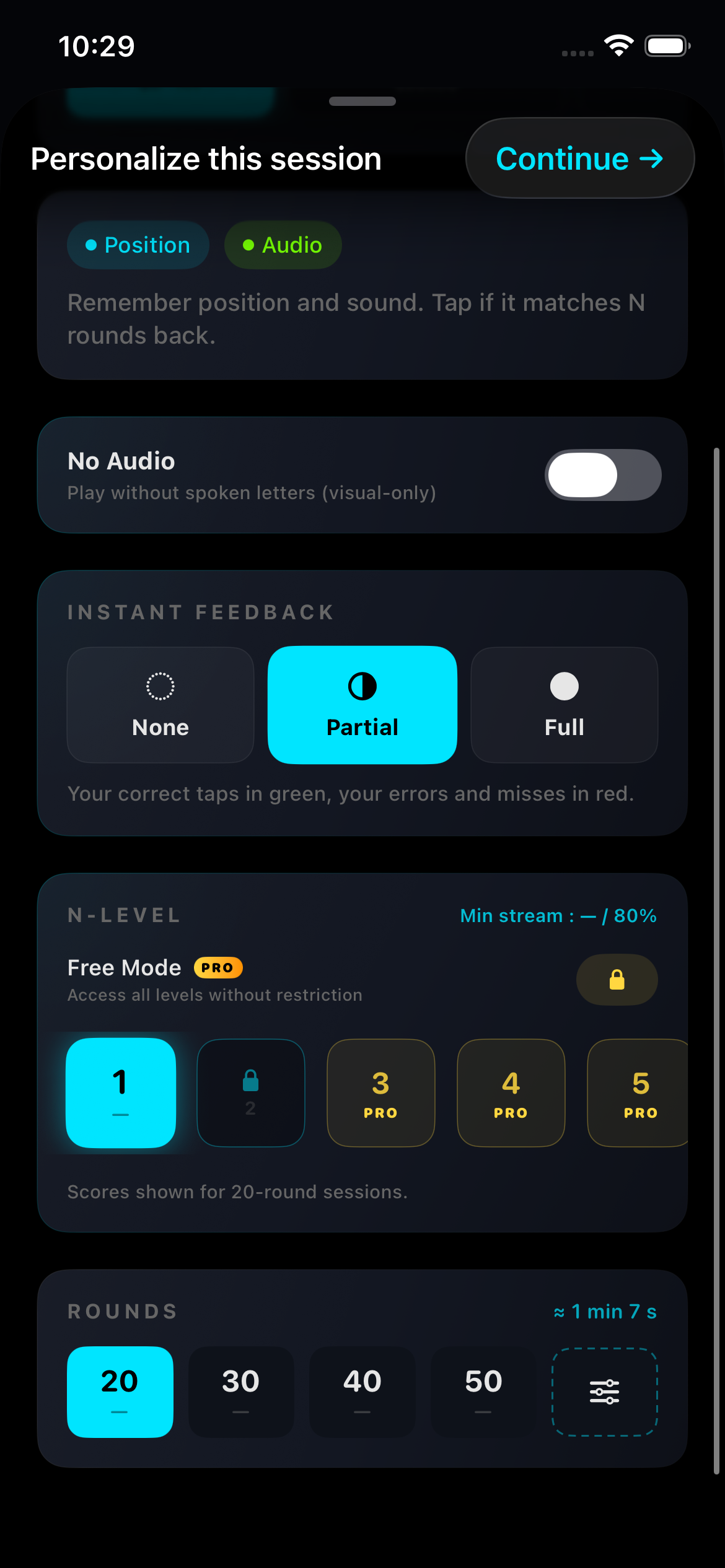
Actual app capture · September 2026 · interface language may differ · EN · 2026-09-06
No Audio: remove the spoken-letter stream
When the No Audio setting is enabled, the spoken-letter stimuli are removed from the session. In the standard dual task, only the position stimuli remain. This changes the task. Record the result as a session without audio, since it is different from a complete session with both position and sound stimuli. If you intended to practise both types of stimuli but hear nothing, turn off this setting and check the sound output of your phone.
No sound in dual n-back on iPhone? Checks to tryImmediate feedback: None
The None setting hides the visual feedback that tells you whether your answer was correct during the exercise. It does not change the n-back comparison rule or prevent the session from being scored. Choose this setting to practise without seeing the correctness feedback after each comparison step, then read the results at the end. A presentation that feels harder does not prove greater cognitive benefit.
Immediate feedback: Partial and Full
The Partial setting shows correctly detected matches in green, and missed matches or false alarms in red. It does not display visual feedback for a non-match that you correctly left unanswered. The Full setting also shows these correct rejections, so every active type of stimulus receives visible correctness feedback after each scored comparison step. Keep the same feedback setting when comparing sessions.
N level: change the comparison distance
At N=1, compare with the previous stimulus; at N=2, with the stimulus two steps earlier; at N=3, with the stimulus three steps earlier. When both sound and position are active, compare each type separately. Changing N does not change the number of stimulus types. Choose an available level whose rule you understand before interpreting the score.
N-back levels explained: N=1, N=2, N=3 and beyondProgression locks and Pro access are different
The app distinguishes progress earned through practice from features that require a purchase. In the progression logic checked for this guide, completing a session at the highest currently unlocked level with at least 80% accuracy for each active type of stimulus unlocks the next level. A Pro label indicates a separate purchase restriction: repeating sessions does not remove it. Check the labels and purchase screen in your installed version; this guide does not promise that a particular level is free of charge.
Free Mode: choosing a level directly
The Free Mode option lets you select an N-level without first unlocking it through practice. The English word “Free” in this label describes freedom of selection, not a zero price. This option is included in Pro access in the app configuration checked for this guide. It is useful for choosing an available practice difficulty directly, but skipping progression does not change what the score means.
Number of trials: choose the length of a session
The screenshot offers sessions of 20, 30, 40 or 50 trials, plus a control for a custom number of trials. A longer session contains more decisions; it does not mean a higher N-level. The score indicators can depend on the selected trial count, so a record achieved in a short session is not automatically a record for a longer session. The displayed duration is an estimate, not a required training dose.
Dual n-back scoring: formulas, examples and calculatorExample: learn the controls
For a first practice session, you could select an available N=1 level, keep sound enabled for the dual task, choose the Partial or Full feedback setting and select a short session. Identify the two response buttons before starting. This is a practical example for learning the interface, not a scientifically validated training programme or a guarantee of improvement.
Example: compare sessions fairly
Choose the same mode, audio setting, N, round count and feedback for the sessions you want to compare. Record interruptions and changes of device. If you try N=3 after N=2, start a separate comparison group. Use the results and scoring guide to distinguish errors; neither configuration is an IQ test.
Track dual n-back progress: a practical session logA setting is unavailable or the result changed
Read the label first: a progression requirement, a Pro restriction and an unavailable score are different situations. If sound has disappeared, check the No Audio setting and the sound output of your phone. If percentages change after selecting another number of trials, check which sessions the indicator summarises. If your interface differs from the screenshot, note the app version and the steps you followed before contacting support; do not send payment details.
Further reading
Guides

How to play dual n-back: a clear first session
Understand position matches, sound matches and the meaning of N before your first dual n-back session.

Reaction time and the Stroop test: what these tasks actually measure
How a reaction-time task differs from a Stroop task, what each one loads, why your scores swing so much, and how to compare results without fooling yourself.

How long and how often to train dual n-back: what the studies actually did
Session lengths and frequencies used in dual n-back research, what the evidence shows about transfer, and how to set realistic expectations.

What is working memory? A plain-language explanation
Where the idea of working memory comes from, how researchers measure it, why its capacity is limited, and what an n-back task actually asks of it.
Does dual n-back training work? What the evidence actually says
An honest walk through the research on dual n-back: what improves, what does not, why the meta-analyses disagree, and how to train without fooling yourself.
N-back levels explained: N=1, N=2, N=3 and beyond
Understand what changes at each n-back level, compare position and sound correctly, and choose a difficulty using accuracy rather than an arbitrary target.
Ten dual n-back mistakes that quietly stall your progress
The habits that make dual n-back scores look better than they are, from guessing and level-chasing to training tired, and what to do instead.
Dual n-back scoring: formulas, examples and calculator
Understand hits, misses and false alarms in dual n-back. Compare scoring formulas with a worked example and an interactive calculator.
Brain-training exercises compared: what each one actually measures
Dual n-back, digit span, complex span, Stroop, reaction time and commercial brain-training suites, what each demands, and what the evidence supports for each.
Single vs dual n-back: what changes and where to start
Compare single and dual n-back with a worked 2-back example. Understand streams, difficulty and what your results can actually tell you.
Track dual n-back progress: a practical session log
Use a simple dual n-back session log to compare levels, accuracy and errors fairly. Includes a fictional worked example and a weekly review method.
How to increase your IQ: evidence and dual n-back
Can you increase your IQ? Understand education, practice effects and the limits of brain training, then learn how to practise dual n-back on iPhone.
Chimp memory test: rules, examples and scores
Understand the chimp memory test, practise remembering numbered positions and compare scores fairly. Discover the memory exercises in Dual N-Back for iPhone.
Visual memory vs sequence memory: which task to choose?
Learn the difference between remembering a pattern, an ordered sequence and a numbered layout. Simple examples help you choose a memory exercise on iPhone.
How to remember what you study: recall and spaced review
Use active recall, feedback and spaced review to study a subject. Follow a concrete example and understand how learning a course differs from dual n-back.
No sound in dual n-back on iPhone? Checks to try
Cannot hear the letters in dual n-back? Check iPhone media volume, Bluetooth output and app settings, then gather useful details if the problem continues.
How to build a dual n-back routine you can read honestly
A practical way to choose settings, keep sessions comparable and learn from errors without turning one score into a promise.
Stroop Effect Test: How Cognitive Control and Inattention Are Measured
How color-word conflict measures response inhibition, selective attention and mental processing speed, and how to train your scores on iPhone.
Reaction Time Training: How to Measure and Improve Processing Speed
The science of human response speed, visual versus auditory reaction times, and practical drills to train processing speed.
Working Memory vs Short-Term Memory: The Key Difference and How to Train It
Understand why short-term memory is passive storage while working memory is active manipulation, how it predicts fluid intelligence, and how to strengthen cognitive control.
Fluid Intelligence and Brain Training: What the Science Actually Shows
An objective look at fluid reasoning, the Jaeggi Dual N-Back research, near transfer, and how deliberate practice trains interference resolution on iPhone.