Dual N-Back · Guides
Visual memory vs sequence memory: which task to choose?
Learn the difference between remembering a pattern, an ordered sequence and a numbered layout. Simple examples help you choose a memory exercise on iPhone.

In this guide6
Are visual memory and sequence memory the same?
A visual pattern task asks which locations were occupied. A sequence task asks in which order locations appeared. Both can use a grid, but they require different answers. Their scores are not interchangeable. This guide compares common task formats rather than diagnosing memory ability or claiming that one game improves every kind of memory.
Remembering a pattern
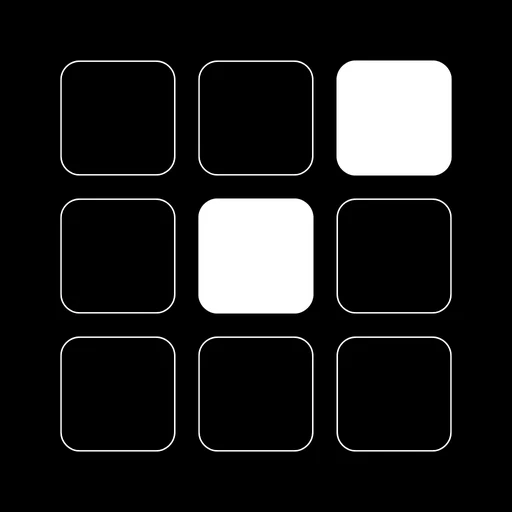
Suppose three squares light up together: top left, centre and bottom right. In a pattern-recall task, you identify those three locations after the display disappears. Unless the rules say otherwise, selection order is not the information being tested. A practical approach is to notice the overall shape, then check each location. Do not assume that remembering the shape guarantees a correct response.
Three tasks, three different rules
Remembering a sequence
Now suppose the centre lights up, then the top left, then the centre again. The answer is centre, top left, centre. Selecting each occupied square once would lose the repeated position and the order. Follow every step, including repetitions. A longer sequence and a faster presentation change different aspects of difficulty, so record both when comparing attempts.
Where numbered tiles fit
The chimp memory task adds numbers to locations and later hides them. You select the remembered locations in numerical order. Unlike a flashing sequence, the order is encoded by the numbers rather than necessarily by the order of presentation. Unlike a simple pattern, knowing which locations were occupied does not tell you which to select first.
Chimp memory test: rules, examples and scoresHow to compare your results
Compare results within the same exercise and settings. Record grid size, number of targets or steps, viewing time and error rules. Repeated locations, distractors and touchscreen input can also differ between implementations. An eight-step sequence is not equivalent to eight simultaneously displayed squares. Keep separate records rather than building an IQ estimate from unrelated game scores.
Choose an exercise for a clear purpose
Choose a pattern task to practise recalling a layout, a sequence task to practise order, or dual n-back to practise comparing a continuous stream with earlier signals. These are descriptions of the exercises, not promises of broad transfer. The Dual N-Back App Store listing includes visual memory and sequences. Check current features before downloading, and use the guide to the n-back rules if you want to try that different task.
How to play dual n-back: a clear first sessionFurther reading
Guides

How to play dual n-back: a clear first session
Understand position matches, sound matches and the meaning of N before your first dual n-back session.

Reaction time and the Stroop test: what these tasks actually measure
How a reaction-time task differs from a Stroop task, what each one loads, why your scores swing so much, and how to compare results without fooling yourself.

How long and how often to train dual n-back: what the studies actually did
Session lengths and frequencies used in dual n-back research, what the evidence shows about transfer, and how to set realistic expectations.

What is working memory? A plain-language explanation
Where the idea of working memory comes from, how researchers measure it, why its capacity is limited, and what an n-back task actually asks of it.
Does dual n-back training work? What the evidence actually says
An honest walk through the research on dual n-back: what improves, what does not, why the meta-analyses disagree, and how to train without fooling yourself.
N-back levels explained: N=1, N=2, N=3 and beyond
Understand what changes at each n-back level, compare position and sound correctly, and choose a difficulty using accuracy rather than an arbitrary target.
Ten dual n-back mistakes that quietly stall your progress
The habits that make dual n-back scores look better than they are, from guessing and level-chasing to training tired, and what to do instead.
Dual n-back scoring: formulas, examples and calculator
Understand hits, misses and false alarms in dual n-back. Compare scoring formulas with a worked example and an interactive calculator.
Brain-training exercises compared: what each one actually measures
Dual n-back, digit span, complex span, Stroop, reaction time and commercial brain-training suites, what each demands, and what the evidence supports for each.
Single vs dual n-back: what changes and where to start
Compare single and dual n-back with a worked 2-back example. Understand streams, difficulty and what your results can actually tell you.
Track dual n-back progress: a practical session log
Use a simple dual n-back session log to compare levels, accuracy and errors fairly. Includes a fictional worked example and a weekly review method.
How to increase your IQ: evidence and dual n-back
Can you increase your IQ? Understand education, practice effects and the limits of brain training, then learn how to practise dual n-back on iPhone.
Chimp memory test: rules, examples and scores
Understand the chimp memory test, practise remembering numbered positions and compare scores fairly. Discover the memory exercises in Dual N-Back for iPhone.
How to remember what you study: recall and spaced review
Use active recall, feedback and spaced review to study a subject. Follow a concrete example and understand how learning a course differs from dual n-back.
No sound in dual n-back on iPhone? Checks to try
Cannot hear the letters in dual n-back? Check iPhone media volume, Bluetooth output and app settings, then gather useful details if the problem continues.
Dual N-Back settings on iPhone: audio, feedback and levels
Understand audio, feedback, N-levels, progression locks and session length with an annotated screenshot of the Dual N-Back iPhone app.
How to build a dual n-back routine you can read honestly
A practical way to choose settings, keep sessions comparable and learn from errors without turning one score into a promise.
Stroop Effect Test: How Cognitive Control and Inattention Are Measured
How color-word conflict measures response inhibition, selective attention and mental processing speed, and how to train your scores on iPhone.
Reaction Time Training: How to Measure and Improve Processing Speed
The science of human response speed, visual versus auditory reaction times, and practical drills to train processing speed.
Working Memory vs Short-Term Memory: The Key Difference and How to Train It
Understand why short-term memory is passive storage while working memory is active manipulation, how it predicts fluid intelligence, and how to strengthen cognitive control.
Fluid Intelligence and Brain Training: What the Science Actually Shows
An objective look at fluid reasoning, the Jaeggi Dual N-Back research, near transfer, and how deliberate practice trains interference resolution on iPhone.